RCM Origin Stories: Reflections from Our October Monthly Meet-up
5 November 2026 · 10 min read
By Cassandra Gould van Praag , Danny Garside , Emma Karoune and Michael Donnay
On 21st October 2026, we hosted our second RCM Cooperative Monthly Meet-up. 42 people registered and 27 joined us live. Here’s a summary of what we discussed, including the common thread of arriving at the RCM role by accident, the question of how we help others understand our work, and in-progress collective RCM origin stories for different audiences.
Slight caveat that we are a group of people who get nerdy about organising events and facilitating discussions, so we’ll say a bit about what we did, but also get a little meta on why we did it that way, and what worked (/didn’t)!
The session was hosted by Danny Garside and featured a presentation from Michael Donnay.
You can rewatch the recording of the session here.
What happened
Our objectives for the session were to explore how we can use narratives, especially origin stories, to help RCMs describe what their job is to people who don’t know it — building a shared identity internally and making RCM work understandable to folks outside of this profession.
We kicked off the session with an icebreaker: in small groups we did a “desk treasure hunt”. Danny really likes these - they give us all an opportunity to (optionally and consensually) share parts of us that aren’t often given space in professional environments, and allow us to connect more holistically, reminding ourselves and each other that we are more than faces (and cute backgrounds) in a zoom call. They’re important moments to get to know other RCMs, and build the relationships which will support collaboration across the community.
Michael introduced the topic of narratives by sharing his own origin story, tracing an unexpected path that connected network analysis and theatrical production to community management.
He framed this as an illustration of a central argument: that origin stories serve two purposes — they provide a foundation for a community to develop a shared identity, and they make that community legible to people outside it.
Exercise 1: Personal origin stories
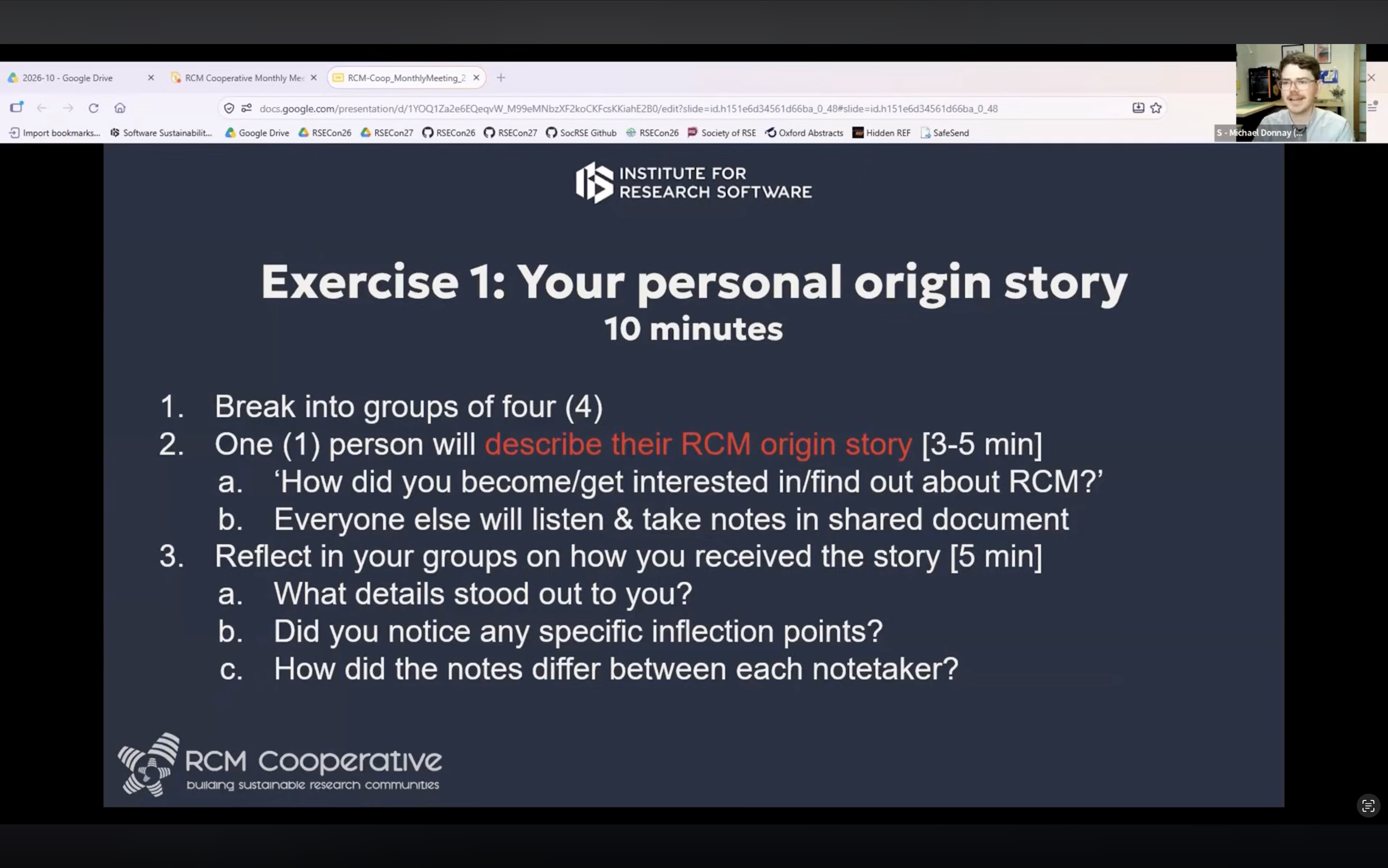
Participants broke into small groups, where one person shared how they came to work in research community management while the rest listened and took notes. Groups then reflected on what they had heard: what details stood out, whether they could identify inflection points in the story, and how their notes compared with one another’s.
The role of narratives
We then came back together, and Michael developed the theoretical framing for the session, drawing on Benedict Anderson’s Imagined Communities and community of practice theory. He illustrated the argument using three different origin stories for the Digital Humanities field — the same field framed three distinct ways, each foregrounding different values and speaking to a different audience. He introduced the criteria for a good narrative: concise, easy to remember, written for an audience (often the educated non-expert), appropriately detailed, and offering an entrance into the community — a quality known as ‘generous exclusion’.
Exercise 2: The RCM origin story
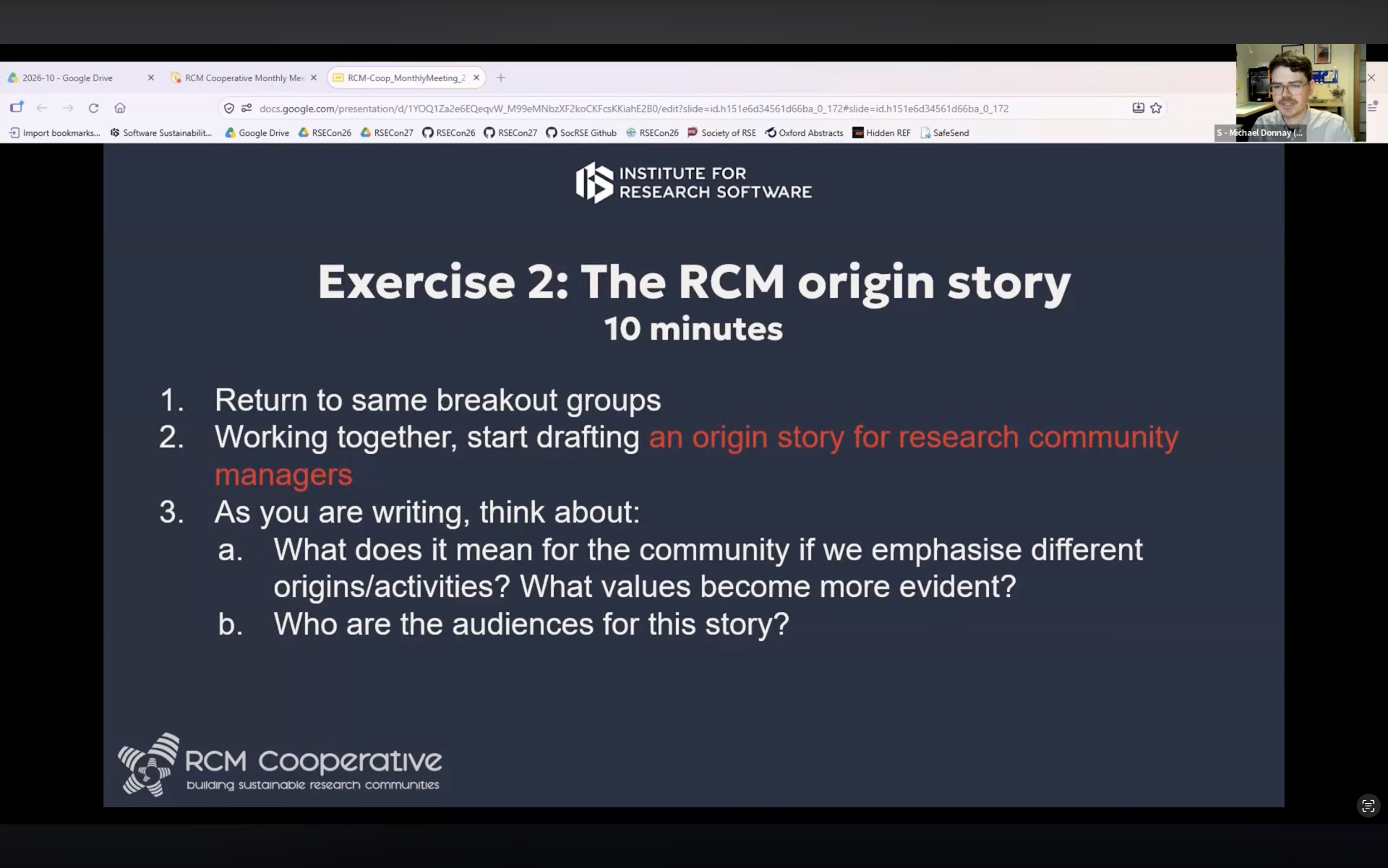
We sent groups back to their break-out rooms with the challenge of drafting a collaborative origin story for research community managers as a whole. The goal was not to find a single definitive story but to identify common themes and useful narratives for people to draw on when advocating for the RCM role in the future.
Findings from the session
Five themes emerged consistently across the discussions.
Arriving at the role by accident. Participants described discovering community management through organising events, joining open science networks, or being drawn into roles that suited them before they had a name for the work. One participant’s description of their path as “very random and opportunistic” drew strong agreement from others in the chat.
The in-betweenness of the work. Across the discussions, participants described the RCM role as occupying the space between researchers, teams and ideas — a facilitating function that is hard to describe because it is relational rather than technical. This in-between quality is both what makes the role distinctive and what makes it easy for the work to go unrecognised.
Professionalisation makes informal work visible. Several groups connected the emergence of the RCM role to a broader argument: that formalising what has often been voluntary or unacknowledged labour is what prevents it from being lost. The case for the role, participants suggested, is partly a case for recognition and sustainable funding.
The RCM community is itself part of the origin story. A recurring theme across the discussions was the value of a community for community managers — a place to share practices, avoid reinventing the wheel, and direct some energy towards supporting one another.
The same story can be told differently for different audiences. Participants noted that the right framing depends on who you are speaking to: RSEs and adjacent communities, institutions and funders, or people who are still finding their way into the field each call for a different emphasis.
Our collective story
The following is a synthesis built from fragments of those origin stories — it is not something any single group wrote, and we offer it as a starting point for further collective work rather than a finished product.
For internal audiences and members of RCM Cooperative:
Many of us stumbled into this work ‘by accident’ and everyone has their own path into community management. In the RCM role and the RCM Cooperative, we have found a professional identity and a community that sustains it.
“Most of us didn’t plan to become Research Community Managers. We were organising seminars, joining open science networks, managing communities on the side of other roles — doing the work before we had a word for it. What brought us together was recognising that others were doing the same thing: navigating the same in-between spaces, filling the same gaps, without a shared framework or a place to compare notes.”
For institutions, funders, senior researchers unfamiliar with the role:
Research communities depend on work that happens in the spaces between people and ideas. That work gets lost without someone able to focus on it and a profession to drive it forwards.
“There is essential work happening in the gaps of the research ecosystem: facilitating conversations, connecting people across boundaries, maintaining the conditions that make collaboration possible. For a long time this work was informal, underfunded, and largely invisible — done on the side of other roles, or as voluntary labour. Naming it ‘Research Community Management’ was not just a career hat. This facilitation is real, valuable, and worth sustaining. Without professionalisation, the work — and everything it enables — gets lost at the boundary.”
For RSEs and adjacent technical communities:
RCMs value the ‘hidden work’ that makes research possible and share an affinity with other research technical professionals for facilitating. RCMs might focus more on the social infrastructure, but hold similar values to technical research teams.
“Research Community Managers come from many backgrounds, but we tend to arrive by a similar route: at some point, we realised that what we most wanted to do was make the conditions for others’ work better, not advance our own output. That instinct — caring more about facilitating than advancing our own research - is what unites us across different fields and organisations. We are not so different from technical research teams in what we value, only in where we direct it.”
Please use and share these narratives! Let us know if something resonates, or conversely if you don’t see yourself represented here. These ideas, stories, and definitions will continue to evolve.
Reflecting on the session
These calls is a fairly new endeavour for RCM Cooperative, and we love to get nerdy about organising effective events and meetings, so we always spend some time reflecting on what worked and where we might want to try something different.
What worked
The feedback poll suggested the session was particularly effective at building professional identity and connecting participants with one another. Of the 18 people who responded, 83% agreed or strongly agreed that the session strengthened their ability to describe or advocate for RCMs as a professional role, 78% that it connected them with others who can support their community work, and 56% that it gave them skills, tools or practices to apply in their own community work.
Room to grow
We definitely tried to fit a lot in this session - perhaps too much?! Only one group managed to work through both exercises to completion, but all groups produced some really valuable notes. Every new exercise is an experiment, and this is one we’d be very pleased to refine and repeat!
We also had some really useful feedback about our icebreaker tasks and subsequent breakout groups. When planning the session, we intentionally put people in different breakouts for the icebreaker and the exercises (the two exercise tasks were completed in the same groups), because we wanted to give participants the chance to meet as many people as possible! We’re so pleased that one participant was able to give us honest feedback after the session that the regrouping was disruptive to the co-creation exercises - they had spent time getting to know people in the icebreaker, then had to start fresh with a new group in the exercises. Moving forward, we will think carefully about how we structure breakout groups, especially where any co-working requires particular emotional vulnerability. We should all work to balance the tread-off between making as many introductions as possible verses nurturing the relationships necessary for deep sharing.
Links
- You can find a full archive of the session materials in our public archive.
- You can rewatch the recording of the session here
Join us next time
Our next Monthly Meet-up is on Thursday 19 November 2026, 13:00 (UK time), and the theme is Communications with your Community. Register here.
You can follow our progress in organising future sessions on the Monthly Meetups issues page. To propose a session, submit an issue using the “Monthly Meetup Suggestion” issue template.
We are also actively looking for speakers and call hosts to lead these sessions, who will each receive an honorarium for their contributions. Speakers and hosts work with Core Members to develop the agenda, creating both an opportunity to showcase their expertise and be part of an expert community management team. Hosts open and close the meeting and are supported by Core members to manage the breakout rooms, chat, and all backstage zoom activity, and they will also be invited to contribute to the blog summary. We have a detailed event planning checklist for us all to work with and develop, helping each meetup to run more effective than the last! We are very pleased to support anyone who would like to host or speak at one of these sessions!
If you’re curious about RCM Cooperative, please come along to a monthly meet-up! You’re also welcome to join our Slack workspace to share and meet with others: please email for the join link: cassandra.gouldvanpraag@rcmcooperative.com.
We look forward to seeing you at our next meet-up!