Building the Network: Reflections from Our September Monthly Meet-up
21 September 2026 · 11 min read
By Cassandra Gould van Praag , Emma Karoune and Alexandra Araujo Alvarez
On 15 September 2026, we hosted our first RCM Cooperative Monthly Meet-up. The session was the external launch of the Cooperative, and we were very pleased with the turn out! 94 people registered and 47 joined us live. This post summarises what we discussed, what worked, what we’re taking forward, and answers the questions the community asked.
This session was hosted by Alexandra Araujo Alvarez (Core Member). Ale has been working with RCM Cooperative on our governance structure, and more recently on a joint grant proposal for some very exciting workshops on AI RCM Workflows (fingers crossed!). Massive thanks to Ale for holding the session together!
You can rewatch the recording of the session here, with a summary of the discussion below.
What happened
Our objectives for the session were (1) share and receive feedback about our Cooperative membership models; (2) build relationships between people doing community work.
We opened with an icebreaker, which was a desk treasure hunt: find something yellow, a book and something natural. We believe that personal relationships can be transformative in how people work together, so we created this small opportunity to intentionally step outside of the usual work introductions and go a little deeper with someone of aligned interests! Sophie Whittle (University of Sheffield, AI and Neurodiversity Community of Practice) shared the yellow packet of Quavers she was snacking on (absolute classic), and Simona Gioè (EMBL Heidelberg) shared her Obsidian vault as the closest thing to a book!
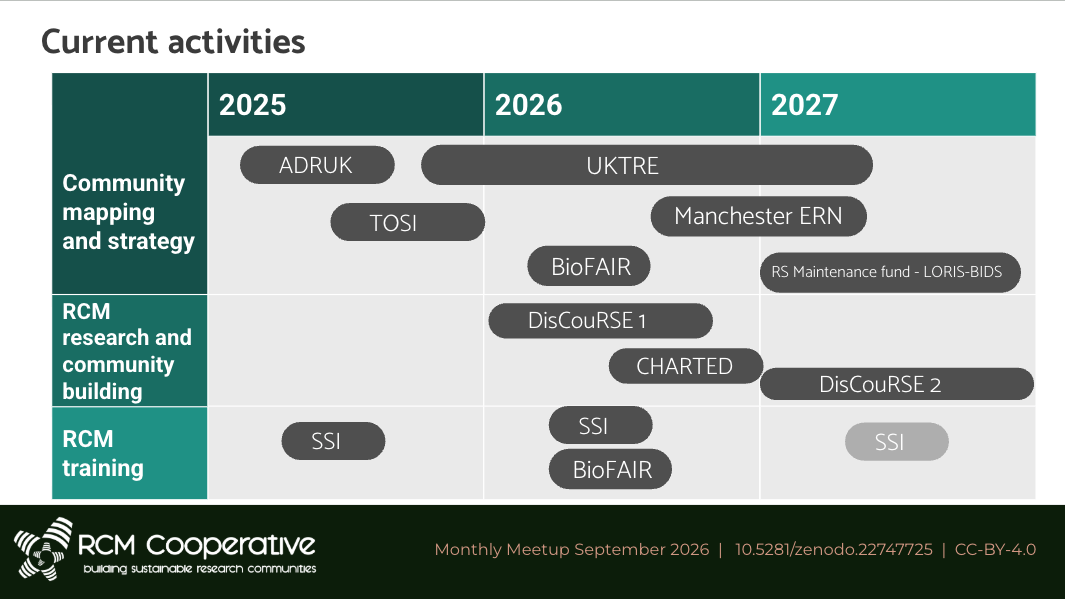
Emma Karoune (Co-Executive Director) then set out the problem RCM Cooperative seeks to address: research community management is skilled, valuable work that is under-recognised and under-supported. We aim to change that by building capacity, networks, and professionalisation for the people doing it, and Emma outlined the projects we’ve led in the last year towards this mission.
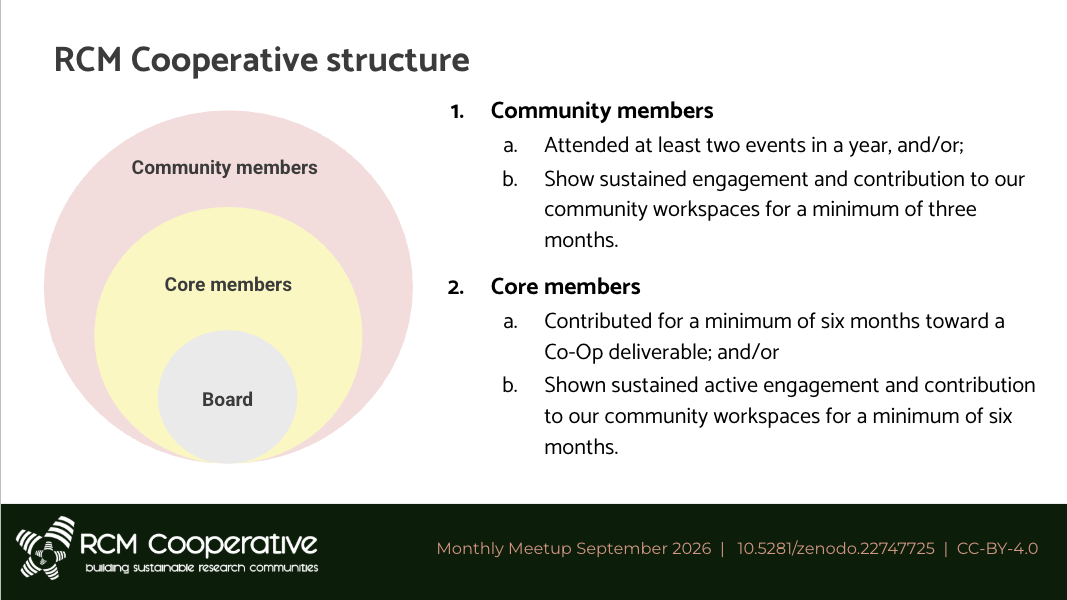
Cassandra Gould van Praag (Co-Executive Director) then explained what a cooperative is, walked through the values and principles of all cooperatives, and how they apply to our own practice. Cass then detailed our proposed two-tier membership structure based on contribution capacity, and gave an example of how voting weight on strategic decisions would apply.
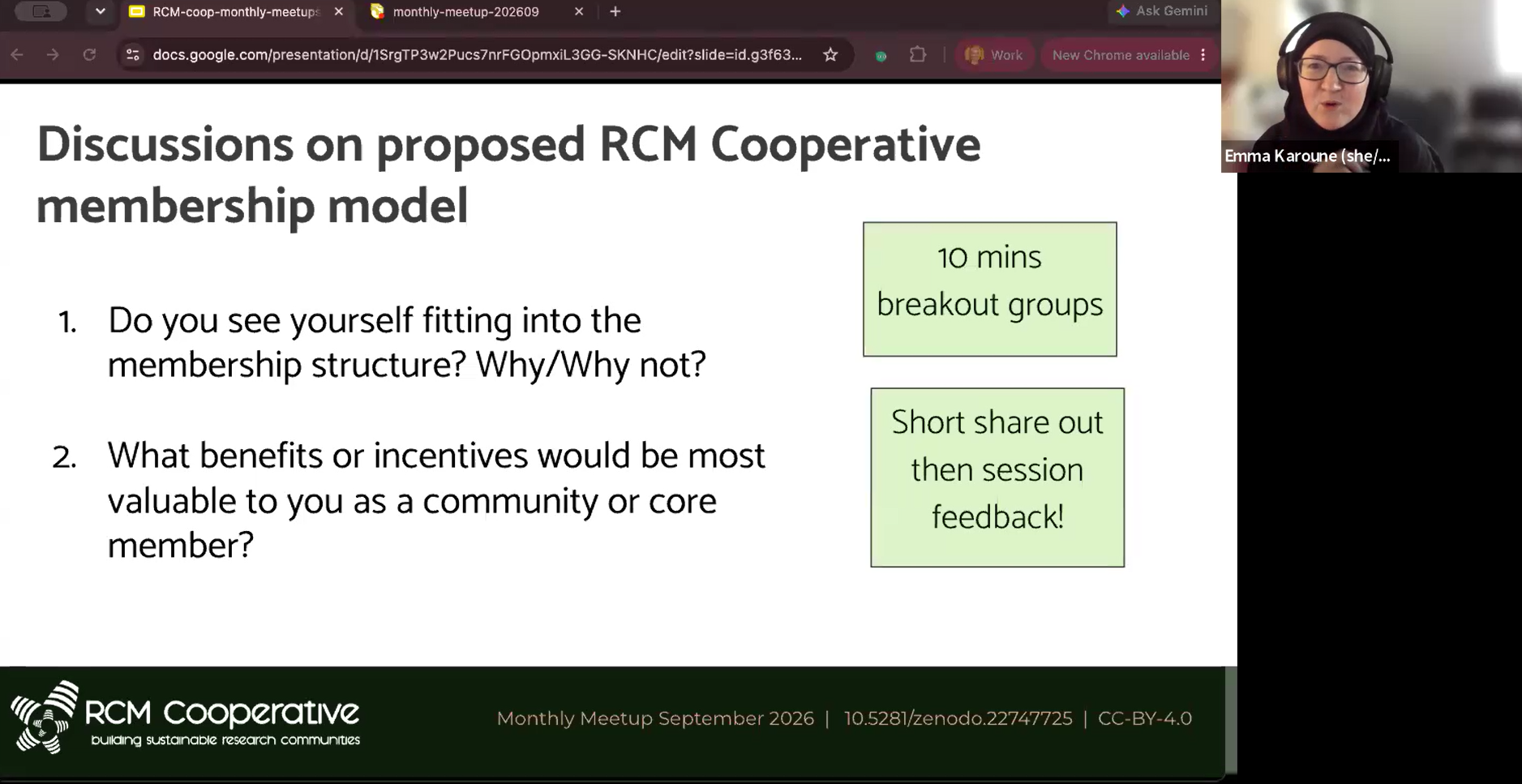
From there, the session moved into breakout rooms, gathering feedback on two questions:
Do you see yourself fitting into the membership structure? Why or why not? What benefits or incentives would be valuable to you for being a Community or Core member?
Around a dozen breakout groups formed and discussed the questions. We were pleased to hear that most attendees could see themselves fitting in as Community members now, with several open to Core membership as capacity allows. Capacity and contract type came up repeatedly as the main barrier to Core membership. People on casual or fully-subscribed contracts, or juggling teaching loads, felt the Community tier was the realistic starting point, even where they were enthusiastic about the Cooperative’s mission.
On incentives, the themes were consistent across groups: peer learning and training, a supported space to share community management problems (“blow off some steam” when work gets tough), and repeatedly a sense of solidarity and advocacy for RCM as a role that’s at risk of being deprioritised or made invisible as organisational narratives shift toward AI.
We were interested to note that no-one mentioned access to funding as a potential benefit of membership! A key feature we’re aiming to build into our offering is redistribution of our profit surplus, to spend in ways which are beneficial to an individual’s RCM work (for example to attend conferences or pay for training). We only hinted at this in our presentation of our structure, so this is something we will work on making more explicit moving forwards ☺️.
What worked well
Feedback form responses suggested this first session was successful in our objective to build relationships between people doing community work: 78% of respondents agreed that the session connected them with others who could support them in the future. Equally when asked “What was the most valuable or successful part of this session?”, responses such as “Meeting new people” and “meeting others doing RCM” came up again and again. Respondents also valued the breakout discussion format, being able to speak, be heard, and learn from each other in smaller groups and “Being in the same space, undistracted to discuss community management”. The description of the RCM Cooperative itself was also valuable and summed up by one person as “a very exciting initiative.”
Room to grow
Two things stood out as areas to improve for next time:
Cryptpad for collaborative notes: One person commented that “they found the CryptPad document very difficult to use when in the breakout rooms, because so many people were typing at once.” This is a known issue with some collaborative documents, and something we will review taking forward. We appreciate this honest feedback. We decided to use CryptPad in this session because the markdown structure can be readily archived in github (see our archive of this months meetup here), and the live notes document itself can be public without being indexed by web crawlers. We will, however, explore other options to see if they better meet our needs for privacy and accessibility.
More time on how to get involved. One respondent wanted more time learning about concrete opportunities to participate. We love this suggestion, and hope to share more opportunities to contribute to this work directly in the coming months!
One current opportunity is to host or suggest a speaker for a future monthly meetup! Here 71% of respondents said they had a suggestion for a talk or speaker, and 50% said they would be interested in hosting a session - we’re excited to follow up directly with these people! We’re very pleased to be able to provide an honoraria for speakers and hosts, furthering our commitment to compensate our members for their contributions.
Open questions from the session
Across the collaborative notes, the feedback form, and the call itself, attendees raised a number of thoughtful questions about the membership model and the Cooperative’s structure that we didn’t get to answer live. We’ve grouped them by theme below.
Is the Cooperative UK-based or international?
Our focus is currently the UK as this is where we have the strongest network and where we have greatest influence. We are, however, able to support and compensate members from outside of the UK, and very pleased for their contributions! We would be interested in expanding more actively outside of the UK when we have capacity.
Where does the funding come from?
Our funding to date has been through competitive grant awards and independent consulting with research funding and performing organisations. We envisage this to continue to be our primary source of income going forwards.
What does Core membership actually involve?
So far our Core members have all worked with us on grant funded projects. They have helped us organise and deliver training for their community members, developed funding proposals which we lead on, and supported our formal recognition and status as a Cooperative. They also join a weekly co-working session (a useful placeholder for project check-ins) and chat with us on slack.
Other funded activities in the pipeline include events organisation, member data management, and continued organisation and delivery of these meetups - these are all activist Core members could support. We’d also love Core members to write and review blogs or documentation. In short, anything which might be valuable to strengthen the growth and success of RCM Cooperative as a community is something we’d really value as contributions from our Core members. We frame these activities as operational areas including communications, engagement, project management, technical and strategic work (see Sharan, et al 2024). If there is something you think we should be doing in these areas, let’s work out a way to make it happen! We’re very open to suggestions here ☺️.
What happens if my capacity or role changes?
At the moment we propose that membership lasts for 1 year after the criteria is reached, but this is something we’re open to feedback on. We fully understand that capacity can change, hence we are only looking for short term (Community member) and medium term (Core member) engagement in the first instance. We will continue to value your input after this initial period ends, so pleased to further refine this model with you.
We were also asked if there could be a lighter category, for example an “participant/audience class” — for people who want to join sessions without voting or contribution pressure. This is absolutely in the plan! Anyone is welcome to join our training, meetups or slack space and participate to any extent they feel comfortable, without being asked to vote or contribute in any depth ☺️.
What would members vote on, and what about quorum?
Voting in cooperatives usually happens annually and is reserved for high strategic decisions, such as:
- Electing fellow members to serve on the Board of Directors or any local member councils to oversee the cooperative’s management.
- Proposed changes to the cooperative’s constitution, rules, or core governing policies.
- Deciding how to allocate annual surpluses, such as issuing member dividends, reinvesting in the business, or funding community initiatives.
- Anything which is required by statute, for example legal activities for incorporated organisations
- Something which might put the cooperative at risk, for example moving out of our Fiscal Hosting and into an incorporated organisation
- Closing down
We expect to grow and detail this list as we continue to formalise our cooperative status with your input. These are a minimum, and we hope to also use this mechanism to test buy-in for other (more fun!) proposals around our strategic direction or priorities.
Members would not be expected to vote on operational activities such as:
- Taking a specific contract or submitting a proposal
- Employment decisions
These will remain with the Board, who are elected by members.
We also presented a proposal for quorum on voting. Quorum sets the turn-out required of each member group for the voting to be considered representative. We proposed a quorum of 50% of Community members, but one person commented that this may be too high given the lower required engagement of this group. We agree that this will be a tricky and important level to get right, and something we will continue to discuss.
How will engagement data be handled?
We are currently developing tooling to understand the health of our community through expansion of previous work (see this example of a community map created by Cass). We are designing this tooling to be free and open source so it can be replicated by other RCMs to understand their own communities, and we are hosting conversations about the ethical collection and management of this data as part of Cass’ Institute for Research Software Fellowship. Our tooling will ensure data is held in accordance with UK GDPR and the privacy policy of our Fiscal Host OLS. Data will not be published without your explicit opt-in consent and will not be shared with third parties outside of the tool suppliers we have engaged following thorough review of their own data privacy and security arrangements. Further documentation on this work will be made available as the project progresses.
Join us next time
Our next Monthly Meet-up is on 21 October 2026, 1–2pm UK time. Register here.
If you’re curious about our work or membership, please come along to a monthly meetup! We currently have funding to run these sessions to late 2027 and we are creating a programme to build both skills and networks in our community!
We are also actively looking for speakers and call hosts to lead these sessions, who will each receive an honoraria for their contributions. Speakers and hosts will work with the Board and Core Members to develop the agenda for the session, creating both an opportunity to showcase their expertise and be part of an expert community management team. Hosts will open and close the meeting, manage zoom chat and breakout rooms, and support post event write up. We are developing documentation to enable reproducible delivery of these activities (we want to make it as easy as possible for you!), and will be very pleased to support anyone to perform this role. Please do not hesitate to reach out if you have any questions about either opportunity!
We’ll also open a GitHub Discussion thread for each open question above, so you can push back, add nuance, or tell us what we’ve missed. In the meantime, you’re welcome to join our slack workspace to share and meet with others - please email for the join link: cassandra.gouldvanpraag@rcmcooperative.com
We look forward to seeing you at our next meetup!